I finished reading Christopher Tozzi’s For Fun and Profit: A History of the Free and Open Source Software Revolution this weekend. Before I rip into this book, let me just give you a disclaimer: I don’t know that much about the FOSS movement. I have a computer science degree, work in tech, and took a class in college on ethical issues related to computing. I’m not claiming to know more than Tozzi on the subject. So if I get something wrong… sorry + I’m totally absolved because I presented a disclaimer.
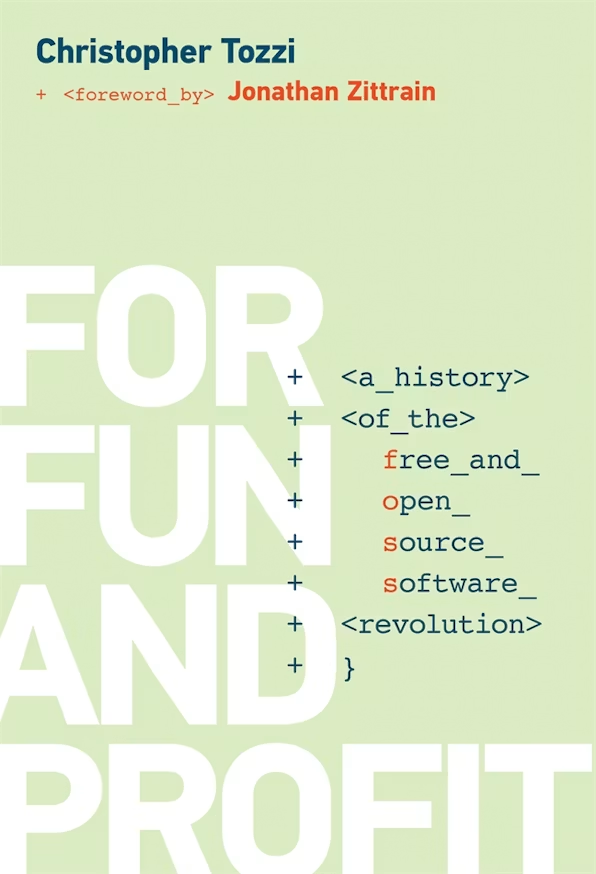
The book is on the more disappointing side of okay. Tozzi makes a tenuous connection between the FOSS movement and the French Revolution of the 1700s all whilst skirting around FOSS’s relevance to more contemporary politics and intellectual property laws. He uses the French Revolution as thematic scaffolding: the French Revolution intended to eradicate inequality in political and social affairs; the FOSS revolution intended to eradicate inequality in… software. They were both radical and revisionist. They both had infighting. But none of these similarities really matter. The resemblances are so incredibly surface-level and understanding one revolution doesn’t really illuminate the workings of the other.
Tozzi’s take on the FOSS movement is neutered in the name of objectivity, but the reader (me) can’t help but wonder if he simply doesn’t know enough to have a take and defend it. He speaks of open source as an end in-and-of-itself. For instance, in his subsection on Android, Tozzi marks it as more or less a success for the FOSS community because of its “market-share conquest”.1 The only point of contention he brings up is that Google downplayed the importance of FOSS to Android and did not attempt to align themselves with the FOSS community. But there was a more nefarious issue Tozzi either deemed unimportant or was unaware of: Google wanted to enter the smartphone market at a time when Apple dominated it. To make it open-source was advantageous to them initially. Once they gained a footing in the market, they slowly replaced open-source software with proprietary software.2 My point being: having code be open-source is not an end in-and-of-itself. A “FOSS success” is not determined by temporary (or even permanent, frankly) open-source-ness of code.
So what does determine a “FOSS success”? The (initial) goals of making software open-source were to support consumer ownership and visibility: you tell the code what to do if you want to, you see what the code does (which is helpful in case it does something not so good). This was at a time when the audience of most software was computer science academics. The goal today remains the same (consumer ownership and visibility), but is open-source enough to accomplish that when the technical proficiency of the consumers of most software has dropped? If pulling out the rug of support services (like Google did with Android) effectively strangles a project, then it might indicate its open-source-ness was never enough to begin with. And if the goal of open-source is not to support consumer ownership and visibility, then what is the goal? If the argument is just that it quickens the pace of development for companies (I want to make a product X that a company A has already worked on. Luckily for me, I don’t need to reinvent the wheel and I can fork off their product), then I wish Tozzi would have made that explicit. On my end, I think both can be true: developers shouldn’t have to reinvent the wheel and consumers should have more visibility into what their software is doing. But that second goal requires more than just code being open-source.
The last 25% of the book explored the ripple effects of the FOSS movement. Tozzi briefly touches on Creative Commons and the application of copyleft licenses to products other than software. This is the section I found the most interesting. Its only three pages long, but you get the slightest hint of some interesting discourse. Intellectual property is a construct; Tozzi never delves into whether or not it is a useful one. It’s not his goal, I guess, but it makes for a very tame book indeed.
This is no fault of Tozzi’s, but I think I simply wasn’t the target audience for this book. I think a good litmus test for whether or not you are the target audience is whether you know who Richard Stallman is. If you don’t, I think this book will introduce you to a part of history that is still relevant to how things operate today. But if you do, then you can probably skip this book.