Jin finds a drawing in his recently-comatose father’s notebook: a simple rectangle accompanied by the phrases “What is invisible and always visible” and “Much ado about nothing” with the word “nothing” underlined several times.
Jin attempts to find this rectangle in towers around Columbus, but is never quite convinced by them. Near the end of the movie, he tells Casey that he believes the drawing reflects this instead:
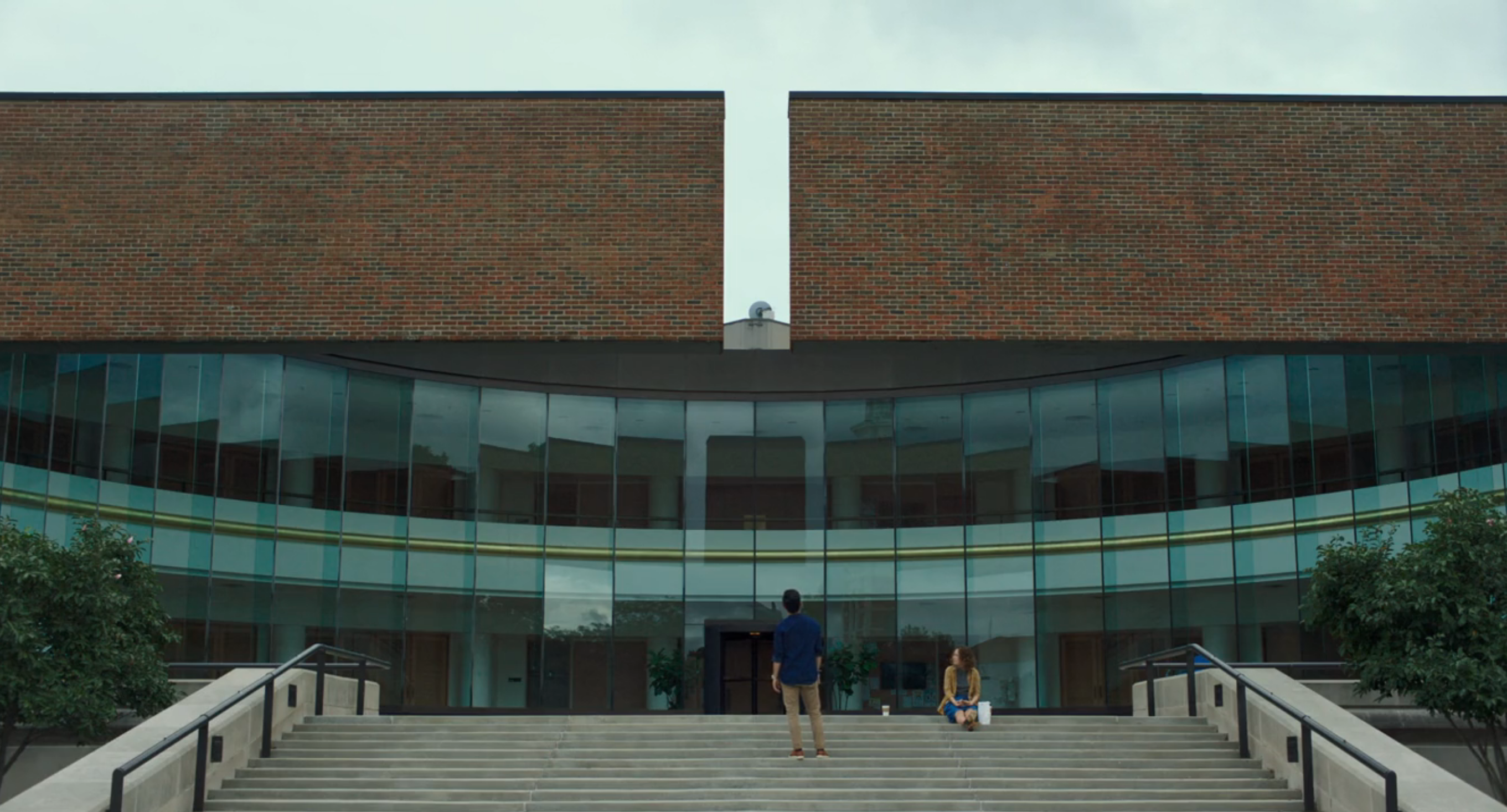
It is a plain building made striking by the piece it lacks. The drawing is not of a rectangle, but of the absence of one.
In much the same way, Columbus is a film about what Casey and Jin are missing, and what has always been missing. The film is about lost opportunities, lost time, and the grief of it all.
When we meet Casey and Jin, neither are satisfied with their lives. Casey loves architecture, but has for the most part given up on pursuing it to take care of her mother, a recovering meth addict. Jin has a strangled relationship with his ill father, who he has come to visit in Columbus. He tells his father’s colleague that they haven’t spoken in a year and though his father is a renowned architect, he himself doesn’t “know shit about architecture… or care.”
And yet, Casey and Jin push each other to change. Casey asks Jin at some point, “Do you think he’s got a chance to recover? Even if it’s just enough to go back to Seoul?” Jin replies, “God, I hope not.” Casey is visibly upset by this. She is devoted so deeply to her mother that she turned down her dream career; she can’t imagine feeling the way that Jin does. She bitterly tells Jin that he doesn’t want his dad to get better simply to avoid to pain of mourning for him.
Jin, in turn, is frustrated by Casey’s inability to follow her passions, always prodding her to open up about her love of architecture despite her guardedness about it. When she is talking about one of her favorite buildings, we see her warbled reflection in the building’s window. Jin challenges Casey to really tell him what it is about the building that moves her instead of simply giving him a “tour guide” explanation. When he prompts her to speak about it, we no longer see her reflection, but Casey herself. We see her mouth move, but can’t hear what she says. Casey’s love swells to a point beyond words. She makes a rectangular shape with her hands. Jin seems to understand.
Despite their arguments, Jin and Casey cannot help that they are now painfully aware of the absences in their lives. Jin attends a tour of a house Casey signed him up for despite earlier proclaiming he didn’t care about architecture. He begins to visit his father more frequently in the hospital.
At the end of the film, Casey decides to pursue her career, particularly after finding out her mom was not using again. And Jin spends more time with his father. He even buys his own apartment instead of moving back to Korea. Jin learns to stay, Casey learns to go.
The building that Jin sees near the end of the movie is Columbus City Hall. Two brick walls extend, “reaching out toward one another yet not quite meeting” (Architect Magazine), like an architectural imagining of The Creation of Adam.
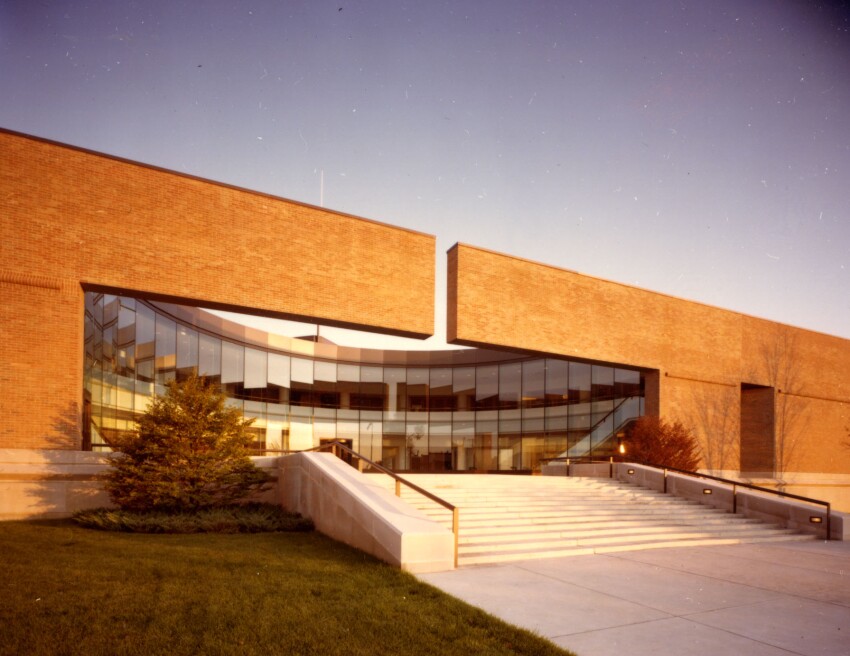
In the context of the film, the gap represents a sort of anti-monument. A common feature of the anti-monument is inversion: voids instead of solids, absence instead of presence, darkness instead of light. Anti-monuments, even moreso than traditional monuments, are linked to loss.
It is of note then that part of what Casey loves about architecture is its solidity. The camera lingers on large structures that assert their presence. The solidity of the architecture is a comfort to Casey against the lack of solidity/stability in her own life. She says when looking up at one of her favorite buildings, “There were nights that my mom just wouldn’t come home at all. I had no clue where she was. That’s when I started coming here. I found it weirdly comforting. In the middle of all the mess, in this fucking strip mall…there was this…This….” She falls silent for a second time and makes a rectangle again with her hands. And just as with the gap in the entrance to Columbus City Hall, we feel the solid shape that hangs in the air.
References